Navigating International Transfers: SWIFT Codes of Major Banks in Albania
If you’re living in Albania, working with an Albanian company, or planning to send money to family and friends, the banking details you need depend on how the transfer is being sent. Albania has been operationally connected to the Single Euro Payments Area (SEPA) since 7 October 2025, so a euro transfer between SEPA-participating institutions is different from a traditional non-SEPA international wire.
For a SEPA-eligible euro payment, the recipient’s IBAN is the main account identifier. A SWIFT/BIC code remains relevant for non-SEPA transfers, payments in other currencies, correspondent-bank routes, and cases where the sending bank or payment form specifically requests it.
SEPA vs SWIFT in Albania
- Albania became operational in SEPA on 7 October 2025.
- 11 Albanian banks now provide SEPA credit-transfer services.
- For an eligible euro SEPA transfer, the beneficiary’s IBAN is the main account identifier.
- SEPA follows an IBAN-only processing model in which the payer generally does not need to provide the beneficiary bank’s BIC for a standard SEPA payment. Some bank interfaces may still display or request a BIC, so follow the instructions shown by your bank.
- For non-SEPA routes, other currencies, or traditional international wires, the recipient bank’s SWIFT/BIC may still be required.
Table of Contents
SEPA vs SWIFT: Which Details Do You Need?
Albania joined the geographical scope of SEPA in November 2024 and became operational for SEPA payments on 7 October 2025. The Bank of Albania says all 11 banks in the Albanian banking system are providing SEPA credit-transfer services.
If you are sending euros between an Albanian bank and another SEPA-participating institution, check whether your bank offers the payment as a SEPA credit transfer. In that case, the beneficiary’s IBAN is the central account identifier.
Under the SEPA IBAN-only model, payment service users generally do not have to provide the beneficiary bank’s BIC for standard SEPA euro payments because the payment provider can obtain the necessary bank-routing information from the IBAN. However, an Albanian bank’s own transfer form or instructions may still ask for or display the BIC, so use the fields requested by the institution processing the transfer.
| Transfer Type | IBAN | SWIFT/BIC |
|---|---|---|
| EUR transfer eligible for SEPA | Main beneficiary account identifier | Usually not required from the payer under IBAN-only processing, although a bank may still request or display it |
| International transfer outside SEPA | May be required when the beneficiary account uses IBAN | Commonly required to identify the beneficiary bank |
| Transfer in another currency | Depends on the destination account | May be required by the sending bank or correspondent-bank route |
Before sending money, check the transfer type offered by your bank rather than assuming every international payment to Albania follows the same route.
What Exactly Is a SWIFT/BIC Code?
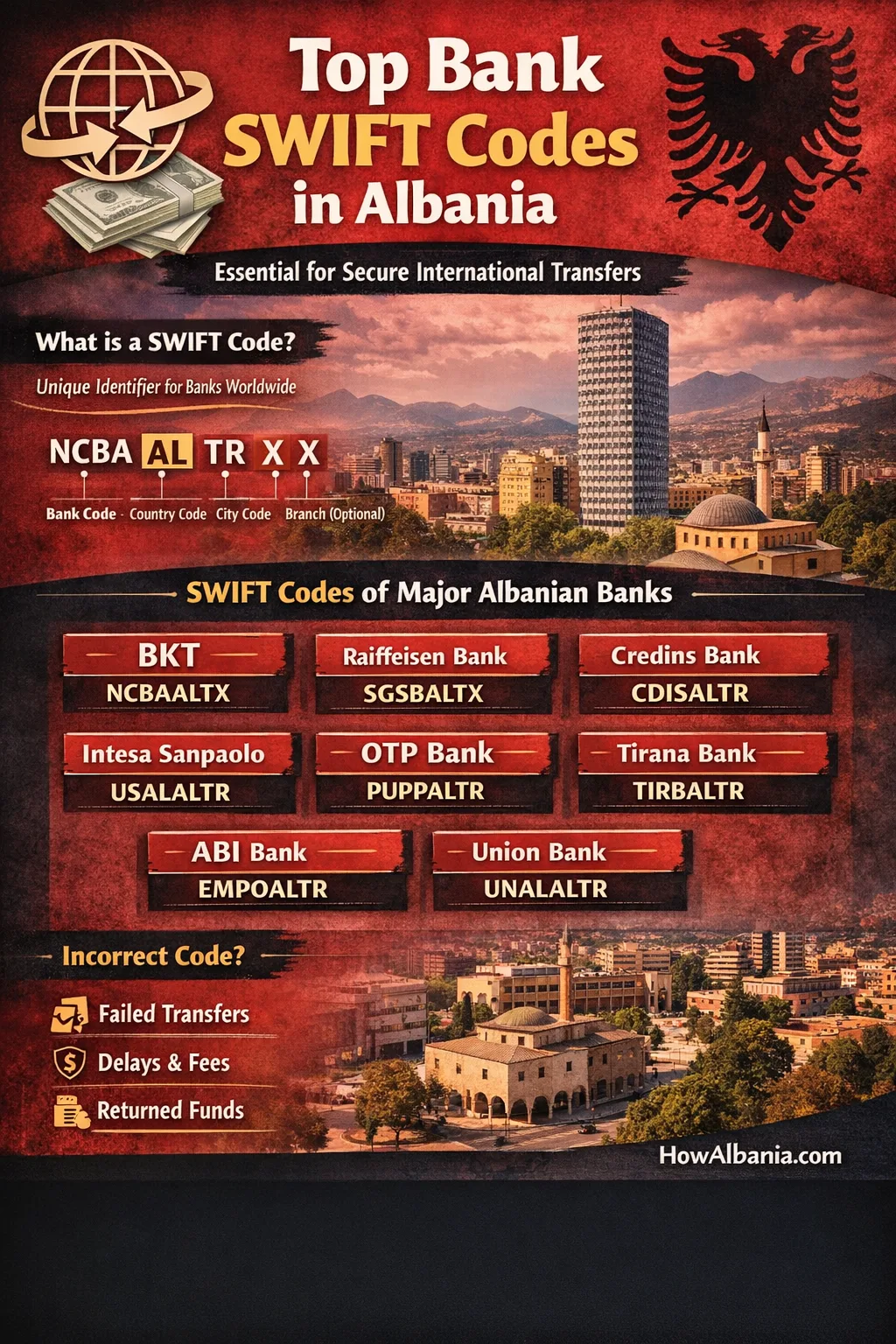
SWIFT stands for the Society for Worldwide Interbank Financial Telecommunication. A SWIFT code, also known as a BIC (Bank Identifier Code), is a standardized identifier for a bank or financial institution.
A SWIFT code is typically 8 or 11 characters long:
- First 4 characters: Bank code (e.g., NCBA for BKT)
- Next 2 characters: Country code (e.g., AL for Albania)
- Next 2 characters: Location code (e.g., TR)
- Last 3 characters (optional): Branch code; XXX commonly identifies the primary office
When a transfer requires SWIFT/BIC information, using the correct code matters. An incorrect code can cause a transfer to be rejected, delayed or returned, and additional bank charges may apply.
SWIFT Codes for Major Albanian Banks
Below are SWIFT/BIC codes for several major banks operating in Albania. Whether you actually need the code depends on the transfer route, currency and instructions from the sending bank.
Before initiating a transfer, confirm the beneficiary’s bank details directly with the recipient or the bank.
Banka Kombëtare Tregtare (BKT)
BKT has a large branch and customer network in Albania and commonly receives domestic and international payments.
SWIFT Code: NCBAALTX
Raiffeisen Bank Albania
Raiffeisen Bank Albania is part of the Austrian Raiffeisen banking group and provides domestic and international banking services.
SWIFT Code: SGSBALTX
Credins Bank
Credins is one of Albania’s main private banks and operates branches throughout the country.
SWIFT Code: CDISALTR
Intesa Sanpaolo Bank Albania
Intesa Sanpaolo Bank Albania is part of the Italian Intesa Sanpaolo banking group.
SWIFT Code: USALALTR
OTP Bank Albania
OTP Bank Albania operates as part of OTP Group following the acquisition of Alpha Bank Albania.
SWIFT Code: PUPPALTR
Tirana Bank
Tirana Bank provides personal and business banking services in Albania, including international payment services.
SWIFT Code: TIRBALTR
American Bank of Investments (ABI)
American Bank of Investments provides personal, corporate and international banking services in Albania.
SWIFT Code: EMPOALTR
Union Bank
Union Bank is an Albanian commercial bank offering personal, business and international payment services.
SWIFT Code: UNALALTR
Verify the Code Before Sending
Bank details can change after mergers, system updates or changes to branch and payment-routing arrangements. If your transfer requires a SWIFT/BIC code, confirm it before sending the payment.
You can verify the details in several ways:
- Ask the Recipient: Request the beneficiary’s current bank details, including the account holder name, IBAN and SWIFT/BIC if the intended transfer requires one.
- Check Bank Account Details: Online banking, account statements or official account-detail documents may show the IBAN and bank BIC.
- Check the Transfer Form: For a SEPA euro transfer, your bank may accept the beneficiary IBAN without requiring you to enter a BIC. For another international route, additional bank details may appear as mandatory fields.
- Contact the Bank: If the details are unclear, ask the sending bank or recipient bank which identifiers are required for the intended currency and payment route.
Frequently Asked Questions (FAQ)
Is a SWIFT code the same as an IBAN?
No. They identify different parts of a bank transfer.
- The SWIFT/BIC identifies a bank or payment service provider.
- The IBAN (International Bank Account Number) identifies the beneficiary’s specific payment account.
You do not need to assume that both must be manually supplied for every international transfer to Albania. For a standard SEPA euro transfer, the IBAN is the main beneficiary account identifier and SEPA supports IBAN-only processing. Some banks may still request or display the BIC. For non-SEPA transfers, other currencies or correspondent-bank routes, a SWIFT/BIC may be required.
Does Albania use SEPA?
Yes. Albania became operational in SEPA on 7 October 2025. The Bank of Albania states that all 11 banks in the Albanian banking system provide SEPA credit-transfer services.
A payment must still meet the conditions for a SEPA transaction. It must be denominated in euro, and the payment institutions involved must participate in the relevant SEPA scheme.
Do I need a SWIFT code for a SEPA transfer to Albania?
Not necessarily as a field that you must manually provide. Under the SEPA IBAN-only model, the beneficiary’s IBAN can provide the information needed for payment processing without requiring the payer to enter the BIC. However, individual bank forms and instructions can differ, so supply a BIC if your bank specifically requests it.
When is a SWIFT/BIC code still important?
A SWIFT/BIC remains relevant when a transfer is outside SEPA, uses another currency, follows a traditional correspondent-bank route, or when the sending bank specifically requires the beneficiary bank’s BIC.
What does the ‘XXX’ at the end of a SWIFT code mean?
When you see a code ending in XXX (such as NCBAALTXXX), it generally identifies the bank’s primary office. An 8-character BIC such as NCBAALTX also identifies the institution without a separate three-character branch identifier. If a bank supplies an 11-character BIC with another branch code, use the details supplied for that particular payment.
What happens if I use the wrong SWIFT code?
If the transfer route requires a SWIFT/BIC and an incorrect code is entered, several outcomes are possible:
- The transfer may be rejected: The sending bank may not recognize or accept the destination details.
- The transfer may be delayed: A bank may need to investigate or correct the payment instructions.
- The payment may be returned: Funds can be sent back if the destination cannot be resolved.
- Extra fees may apply: Banks or correspondent institutions can charge for amendments, tracing or returned transfers.
Verify the requested payment details before confirming the transaction, especially when the transfer is outside SEPA or involves another currency.
Official Sources
- Bank of Albania — First SEPA Transaction in Albania — Confirms the operational launch of SEPA payments on 7 October 2025 and the readiness of all 11 commercial banks to provide SEPA services.
- Bank of Albania — Balkan Payment Forum 2026 — Confirms that 11 banks are making SEPA credit transfers.
- Bank of Albania — Regulation on Euro Credit Transfers and Direct Debits — Covers euro credit transfers within Albania and between Albania and the SEPA area.
- European Payments Council — IBAN and BIC in SEPA — Explains the SEPA IBAN-only rule and how payment providers can derive BIC information from an IBAN.