Figuring out take-home pay in Albania requires more than applying one tax rate to gross salary. Payroll calculations combine personal income tax, employee social insurance, and employee health insurance, with different rules for each. The 2026 contribution bases also changed: the minimum monthly salary is now 50,000 ALL and the maximum base used for social insurance is 186,416 ALL.
This page shows how employment income moves from gross salary to taxable income and then to net salary under the current payroll rules. The examples assume a standard employee with one employer and the personal-status deduction applied through that employer.
Table of Contents
- Gross, Taxable, and Net Salary
- Albania Personal Income Tax on Employment
- Social and Health Contributions
- Monthly Personal Deduction
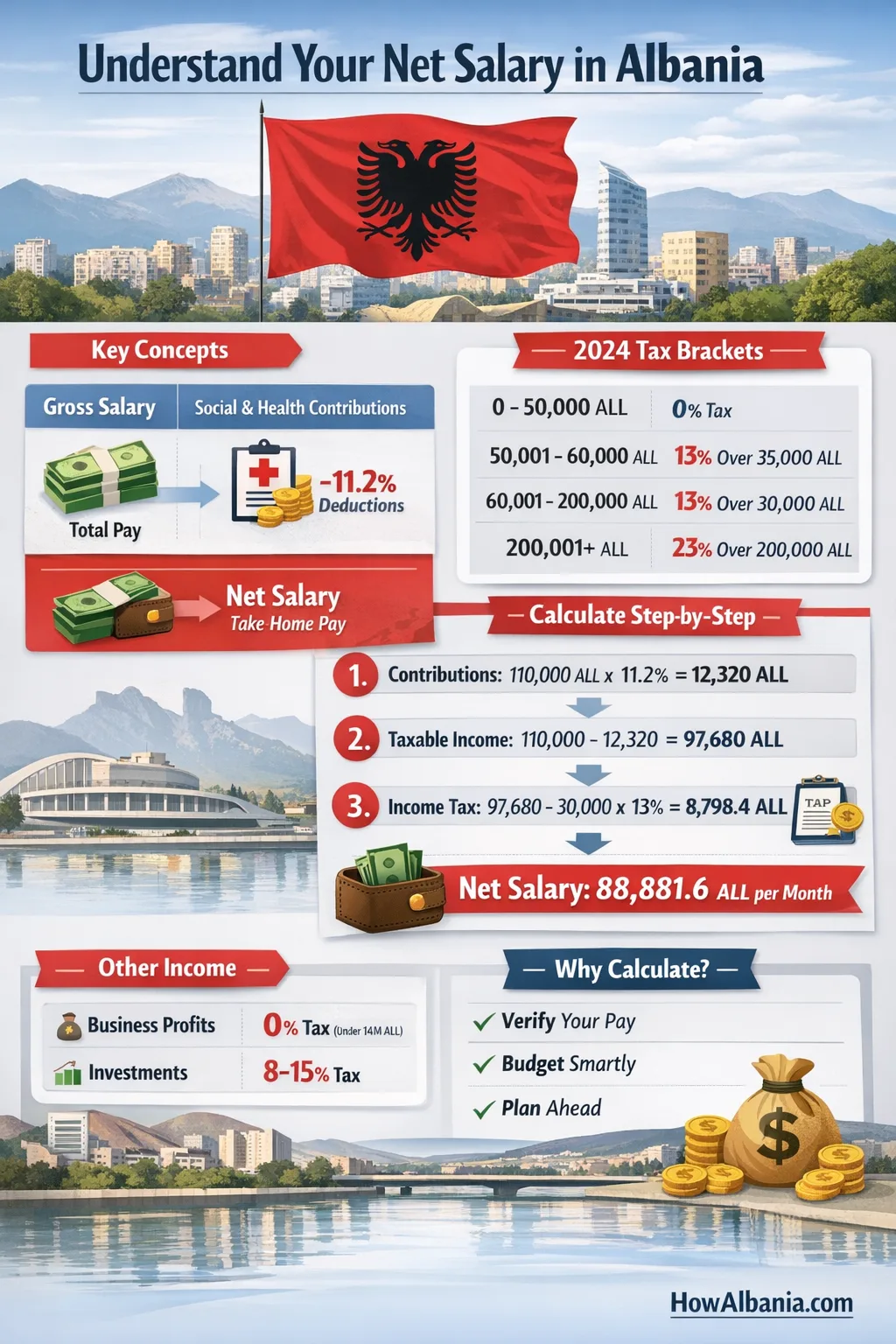
- 110,000 ALL Gross Salary Example
- What Changes Above the Social Insurance Ceiling?
- Business and Investment Income
- Checking a Payroll Calculation
- References
Gross, Taxable, and Net Salary
Several different amounts appear in an Albanian payroll calculation:
- Gross Salary (Paga Bruto): The employment income before employee contributions and personal income tax are withheld.
- Social Insurance (Sigurimet Shoqërore): The employee share is generally 9.5% of the applicable social-insurance salary base.
- Health Insurance (Sigurimet Shëndetësore): The employee share is generally 1.7% of gross salary.
- Employment Income After Contributions: Mandatory employee social and health contributions are deductible when determining taxable employment income.
- Personal Deduction: A monthly deduction can then reduce the taxable amount when the employee has properly submitted the personal-status declaration to the employer applying it.
- Net Salary (Paga Neto): Gross salary minus employee contributions and personal income tax.
Albania Personal Income Tax on Employment
Albania applies progressive taxation to employment income. The current payroll structure uses 13% and 23% rates together with monthly personal deductions that depend on the employee’s monthly employment income.
| Monthly Employment Income | Monthly Personal Deduction | Tax Treatment |
|---|---|---|
| Up to 50,000 ALL | 50,000 ALL | No PIT where the deduction covers the taxable employment income. |
| 50,001 – 60,000 ALL | 35,000 ALL | 13% on taxable employment income above 35,000 ALL. |
| Above 60,000 ALL | 30,000 ALL | 13% on taxable employment income from 30,001 to 200,000 ALL. |
| Taxable employment income above 200,000 ALL | Applicable monthly deduction already reflected | 22,100 ALL + 23% of taxable employment income above 200,000 ALL. |
The tax calculation is not simply a percentage of gross salary. Mandatory employee social and health contributions are deductible for taxable-income purposes, and the applicable personal deduction also affects the amount subject to PIT.
Social and Health Contributions
Employee Share
- Social insurance: 9.5%
- Health insurance: 1.7%
When the full salary is within the social-insurance limits, the combined employee deduction is effectively 11.2%. At higher salaries, however, the two contributions no longer use the same base.
2026 Contribution Bases
- Minimum monthly salary / social-insurance base: 50,000 ALL
- Maximum monthly social-insurance base: 186,416 ALL
- Employee social insurance: 9.5% on the applicable social-insurance base, up to 186,416 ALL.
- Employee health insurance: 1.7% of gross salary; the 186,416 ALL social-insurance ceiling does not cap the health contribution.
Only the social-insurance component has the 186,416 ALL ceiling. Health insurance continues to be calculated on gross employment salary.
Examples:
- At a gross monthly salary of 50,000 ALL, social insurance is calculated on 50,000 ALL and health insurance on 50,000 ALL.
- At 100,000 ALL, both employee components are calculated on the full 100,000 ALL salary.
- At 250,000 ALL, employee social insurance is calculated on the 186,416 ALL ceiling, while employee health insurance is calculated on the full 250,000 ALL.
Monthly Personal Deduction
Since the personal-deduction rules took effect, payroll tax also depends on the employee’s Declaration of Personal Status. The monthly deduction can be applied by one employer for the same calendar month.
- Monthly employment income up to 50,000 ALL: deduction of up to 50,000 ALL.
- Monthly employment income from 50,001 to 60,000 ALL: deduction of 35,000 ALL.
- Monthly employment income above 60,000 ALL: deduction of 30,000 ALL.
If an individual works for more than one employer, the personal-status deduction cannot be applied by every employer for the same month. The employee selects the employer that applies it, while the other employment income may be taxed without that monthly personal deduction and later reconciled where required.
110,000 ALL Gross Salary Example
Assume an employee receives a gross monthly salary of 110,000 ALL, works for one employer, and has submitted the personal-status declaration to that employer.
Step 1: Calculate Employee Social Insurance
The gross salary of 110,000 ALL is below the 2026 social-insurance ceiling of 186,416 ALL, so the full salary is used.
- 110,000 × 9.5% = 10,450 ALL
Step 2: Calculate Employee Health Insurance
Health insurance is calculated on the full gross salary.
- 110,000 × 1.7% = 1,870 ALL
Step 3: Total Employee Contributions
- Social insurance: 10,450 ALL
- Health insurance: 1,870 ALL
- Total employee contributions: 12,320 ALL
Step 4: Determine Employment Income After Mandatory Contributions
- 110,000 ALL gross salary − 12,320 ALL contributions
- 97,680 ALL
Step 5: Apply the Monthly Personal Deduction
Because monthly employment income is above 60,000 ALL, the applicable monthly personal deduction is 30,000 ALL.
- 97,680 ALL − 30,000 ALL
- 67,680 ALL subject to the 13% rate
Step 6: Calculate Personal Income Tax
- 67,680 ALL × 13%
- Income tax: 8,798.40 ALL
Step 7: Calculate Net Salary
- 110,000 ALL gross salary
- − 12,320 ALL employee contributions
- − 8,798.40 ALL personal income tax
- Net salary: 88,881.60 ALL per month
For a gross salary of 110,000 ALL, the 2026 maximum social-insurance base does not affect the calculation because the salary remains below the 186,416 ALL ceiling. Under the assumptions above, the resulting net salary is 88,881.60 ALL per month.
What Changes Above the Social Insurance Ceiling?
The 2026 maximum matters once gross salary exceeds 186,416 ALL. For example, at a gross salary of 250,000 ALL:
- Employee social insurance: 186,416 × 9.5% = 17,709.52 ALL
- Employee health insurance: 250,000 × 1.7% = 4,250 ALL
- Total employee contributions: 21,959.52 ALL
The health contribution does not stop at the social-insurance ceiling. This is why applying 11.2% to the capped amount would understate the employee’s health contribution at higher salaries.
Business and Investment Income
Employment payroll rules do not automatically apply to business and investment income.
- Business income: Net taxable business income is generally subject to the business-income rules under Law No. 29/2023. For individual traders and self-employed persons with annual gross income up to 14 million ALL, the applicable income-tax rate remains 0% through December 31, 2029, subject to the conditions of the law.
- Dividends: Generally taxed at 8%.
- Other investment income: Items such as interest, rent, royalties, and many capital gains are generally subject to a 15% rate, subject to the applicable rules and exemptions.
Self-employed people should not use this employee gross-to-net calculation as a substitute for their business-tax calculation. Their tax base, deductible expenses, contribution rules, and filing obligations can differ from those of an employee.
Checking a Payroll Calculation
A manual calculation is useful when reviewing a job offer or payslip because several amounts need to be treated separately:
- Check the gross salary shown in the employment agreement and payroll declaration.
- Check social insurance against the 50,000–186,416 ALL contribution range.
- Check health insurance separately because the social-insurance ceiling does not cap it.
- Confirm the personal-status declaration if the monthly personal deduction is being applied.
- Check the PIT calculation only after deductible employee contributions and the applicable personal deduction have been considered.
References
- Albanian General Directorate of Taxes — Minimum and Maximum Salary From January 1, 2026 — Official notice confirming the 50,000 ALL minimum salary and 186,416 ALL maximum social-insurance contribution base.
- Albanian General Directorate of Taxes — Personal Status Declaration and Payroll Changes — Official information on monthly personal deductions and use of the declaration by employees.
- Albanian General Directorate of Taxes — Income Tax Legislation — Official legislation page for Law No. 29/2023 and later amendments.
- PwC Worldwide Tax Summaries — Albania Personal Income Tax — Current employment, business, and investment income tax rates.
- PwC Worldwide Tax Summaries — Albania Individual Deductions — Current treatment of mandatory social and health contributions and personal deductions.
- PwC Worldwide Tax Summaries — Albania Payroll-Related Contributions — Current employee and employer contribution bases and treatment of health contributions.
Disclaimer: This article provides general information based on the payroll and income-tax rules currently applicable in Albania. Individual payroll results can differ because of multiple employment, personal-status declarations, voluntary pension deductions, benefits, special employment categories, annual reconciliation, or other circumstances. Check the payroll generated through the Albanian tax system or consult a qualified Albanian accountant for a calculation tied to a specific employment situation.