People considering work in Albania often want a reliable answer to one basic question: “What is the average salary in Albania?”
There is no single salary figure that represents every worker. Pay varies by profession, experience, sector, employer, and location. The figures below provide national and sector reference points alongside estimated profession-level salary ranges.
For context, the Albanian currency is the Lek (ALL). The national minimum wage is 50,000 ALL per month. INSTAT reported an average gross monthly wage of 90,119 ALL in Q1 2026, up 9.6% from Q1 2025.
Currency note:
Salary figures on this page are shown in Albanian lek. EUR, USD, and other currency equivalents change with exchange rates, so use a current currency converter when comparing an Albanian salary with income or expenses in another currency.
Table of Contents
- What Determines Your Salary
- Understanding Gross vs. Net Salary
- Average Salary in Albania by Profession (Table)
- Official Wage Benchmarks by Sector
- High-Demand Sectors
- Salary and Cost of Living
- Sources
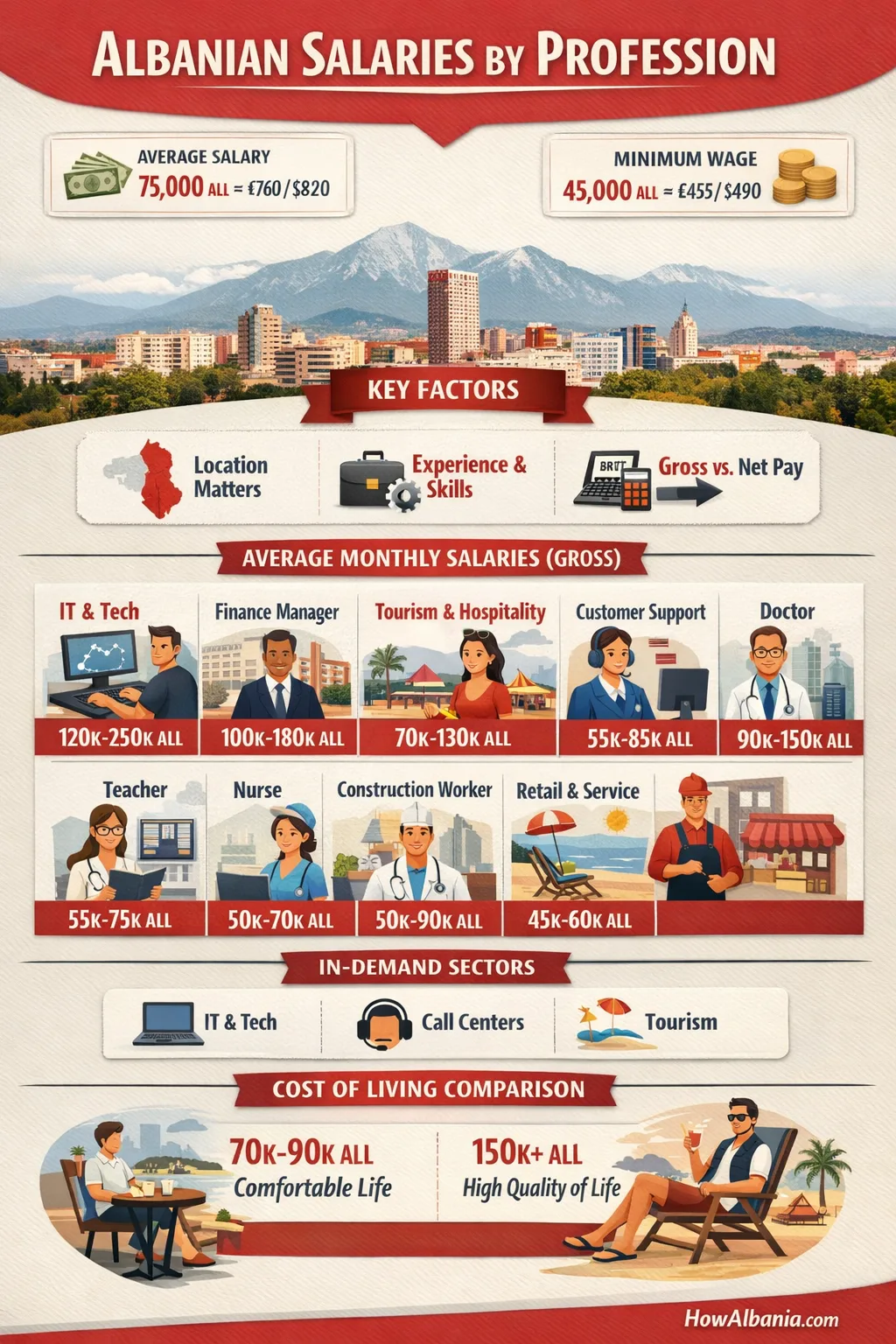
What Determines Your Salary
Before getting into the figures, it helps to understand why pay varies between jobs. A number listed in a job posting rarely tells the whole story.
- Location Matters: Salaries in Tirana can differ from those offered in cities such as Durrës, Vlorë, or Shkodër and from salaries in smaller towns or rural areas. Housing and other living costs also vary by location.
- Experience & Skills: Senior managers, experienced professionals, and specialized technical workers can earn substantially more than entry-level employees. English, Italian, German, and other foreign-language skills can improve employment prospects in tourism, customer support, and international business services.
- Formal vs. Informal Economy: Some employment remains outside formal payroll arrangements, particularly in parts of agriculture, seasonal work, and small businesses. Informal pay should not be treated as a lawful benchmark for a standard declared employment contract.
Understanding Gross vs. Net Salary (Bruto vs. Neto)
This distinction matters when comparing Albanian salaries. A gross salary (bruto) is the salary before employee payroll deductions. A net salary (neto) is the amount received after the applicable deductions are withheld.
Employee deductions can include:
- Social and Health Insurance Contributions: Mandatory employee contributions calculated according to the applicable contribution rules and salary bases.
- Personal Income Tax: Employment income is subject to Albania’s progressive income-tax rules after the applicable deductions and personal allowance treatment.
The difference between gross and net pay is not a fixed percentage for every employee. It changes with salary level, contribution calculations, personal deductions, and other payroll circumstances.
Average Salary in Albania by Profession (Table)
These profession-level figures are estimates rather than official statutory salary scales. They are intended to show broad gross monthly ranges seen in urban employment markets such as Tirana. Actual offers can differ by employer, experience, qualifications, location, working hours, and contract terms.
Minimum-wage check: Albania’s national minimum gross monthly wage is 50,000 ALL. The lower ends of the ranges below therefore should not be read as permission to pay a full-time employee below the applicable legal minimum.
| Profession / Sector | Estimated Gross Monthly Salary (ALL) | Notes & Context |
|---|---|---|
| IT & Tech (Software Developer) | 120,000 – 250,000+ ALL | Specialists and senior developers can receive higher offers, particularly when working with international employers or clients. |
| Finance & Banking (Manager) | 100,000 – 180,000 ALL | Managerial pay varies by institution, responsibilities, experience, and professional qualifications. |
| Tourism & Hospitality (Hotel Manager) | 70,000 – 130,000 ALL | Pay can vary by property size, location, season, experience, and language skills. |
| Customer Support (BPO / Call Center) | 55,000 – 85,000 ALL | Foreign-language ability, shift patterns, and the client account can affect pay. |
| Healthcare (Public Sector Doctor) | 90,000 – 150,000 ALL | Actual public-sector pay depends on position, specialization, seniority, and applicable salary schedules. |
| Healthcare (Nurse) | 50,000 – 70,000 ALL | Pay varies by employer, experience, shift work, and public or private employment. |
| Education (Public School Teacher) | 55,000 – 75,000 ALL | Public-sector salaries depend on the applicable state salary structure, qualifications, and experience. |
| Construction Worker / Skilled Trade | 50,000 – 90,000 ALL | Trade, experience, project type, and responsibility can produce a wide pay range. |
| Retail / Shop Assistant | 50,000 – 55,000 ALL | Entry-level full-time gross pay may sit close to the national minimum wage. |
| Hospitality (Waiter / Barista) | 50,000 – 60,000 ALL | Base pay can sit near the minimum wage. Tips may add to earnings in some establishments but are separate from the contractual gross salary. |
Official Wage Benchmarks by Sector
INSTAT’s Q1 2026 wage statistics provide a more reliable reference for broad economic sectors. The national average gross monthly wage was 90,119 ALL, an increase of 9.6% compared with Q1 2025.
| Official Q1 2026 Benchmark | Average Gross Monthly Wage |
|---|---|
| All Employees | 90,119 ALL |
| Financial and Insurance Activities | 157,434 ALL |
| Information and Communication | 131,747 ALL |
These are sector averages, not guaranteed salaries for a particular profession. For example, the 157,434 ALL finance and insurance figure combines employees with different occupations, responsibilities, and experience levels within that economic activity.
High-Demand Sectors
Several sectors regularly appear in job searches for foreign-language speakers, technical workers, and professionals in Albania:
- IT & Tech: Software development, IT support, infrastructure, and related technical roles can pay above the national average, particularly at specialist and senior levels.
- Business Process Outsourcing (BPO): Call centers, customer support, and back-office operations employ workers with Italian, German, English, Spanish, French, and other language skills.
- Tourism: Hotels, restaurants, tour operators, and other tourism businesses create both seasonal and year-round employment, with pay varying by location, role, and season.
Salary and Cost of Living
A gross salary figure does not show how much money remains after payroll deductions or how far the resulting net salary will go. Housing is particularly important because rents can differ substantially between Tirana, coastal destinations, smaller cities, and rural areas.
When evaluating an offer, compare the net salary with your expected rent, utilities, food, transport, debt payments, and other recurring expenses. Household size and housing arrangements can change the result considerably, so a single salary figure should not be described as universally comfortable or insufficient.
For salary comparisons, the most useful reference points are the 50,000 ALL legal minimum, the 90,119 ALL national gross average, the relevant INSTAT sector data, and the actual gross offer for the specific position.
Sources
- Albanian General Directorate of Taxes — Minimum and Maximum Salary — Official notice confirming the national minimum monthly salary of 50,000 ALL.
- INSTAT — Wage Statistics Q1 2026 — Official publication reporting the 90,119 ALL national average gross monthly wage, 9.6% annual growth, and sector averages including finance and insurance and information and communication.