How to Open a Bank Account in Albania (2026 Guide)
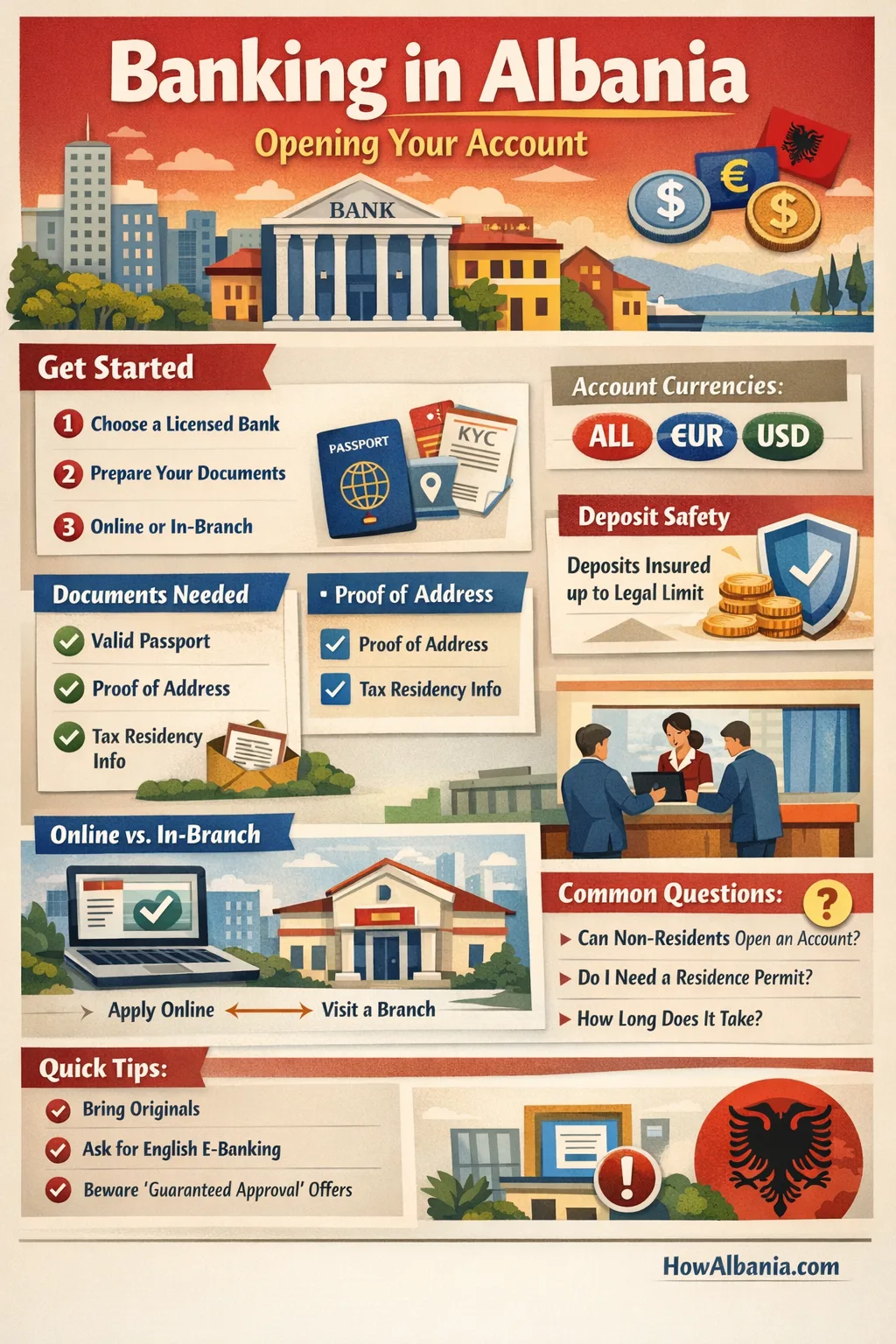
Short answer: Pick a licensed bank, prepare your ID and basic KYC documents (passport, proof of address, tax residency self-certification), then open your account online (where available) or in branch. Most banks offer accounts in ALL, EUR and USD, and deposits are protected by Albania’s deposit insurance scheme up to a legal limit per bank.
Audience: Tourists, digital nomads, new residents, property buyers, and company founders who need smooth, practical banking in Albania.
1) Banking Overview & Who Can Open
Albania’s banking sector is supervised by the Bank of Albania. There are multiple licensed banks (international and local), and foreigners—residents and many non-residents—can usually open accounts. Requirements vary by bank, but the process is straightforward if your documents are in order.
2) Documents You’ll Need (KYC)
Banks must verify your identity and understand the source of funds under Albanian AML rules and international tax-reporting standards (CRS/FATCA). Expect the following:
- Passport (valid, original). Some banks also accept EU ID cards.
- Proof of address (utility bill or rental agreement; sometimes foreign address is acceptable).
- Tax residency self-certification (CRS; FATCA forms for U.S. persons). You’ll normally provide your tax ID where applicable.
- Source of funds (e.g., employment letter, payslip, contract, or bank statement) when requested.
- Local phone number and email for online banking activation (common but not always mandatory).
Optional/Case-by-case: Albanian residence permit or local tax ID (if you have one), secondary ID, or a larger initial deposit depending on the bank and account type.
3) Online vs. In-Branch Opening
Online onboarding is increasingly available via secure video identification in some banks. If your case is non-standard (e.g., complex tax residence, multiple citizenships, company accounts), in-branch opening is often faster and clearer.
- Online: Start from the bank’s official website or app; complete e-KYC, upload documents, and receive your IBAN after approval.
- In-branch: Bring originals; you’ll sign account and privacy forms, CRS/FATCA self-certification, and pick up your debit card (or receive it by mail).
4) Step-by-Step: Opening Your Account
- Pick a licensed bank (compare fees, languages, online banking, card networks, and branch coverage).
- Choose currency (ALL for daily life; EUR/USD for incoming transfers or savings; multi-currency is common).
- Prepare documents (passport, proof of address, tax self-certification details, and—if asked—source of funds).
- Apply online or visit a branch. Ask about minimum balance, card issuance time, and foreign transfer fees.
- Activate digital banking (mobile app + web). Set up 2FA, push notifications, and card controls.
- Receive your card & IBAN. Make a small test transfer to ensure everything works before larger payments.
5) Popular Banks & Useful Features
| Bank (examples) | Notable for | Opening Method | Notes |
|---|---|---|---|
| Raiffeisen Bank Albania | Broad retail offering; strong digital banking | Online & In-branch | Promotes online current-account opening via “Raiffeisen ON”. |
| Tirana Bank | Modern apps; English interfaces | Online & In-branch | Offers digital onboarding for new clients. |
| OTP Bank Albania | Transparent minimums; multi-currency | In-branch (most cases) | Indicative minimum initial balance: 1,000 ALL or 10 EUR/USD/CHF/GBP for current accounts. |
| INTESA SANPAOLO Bank Albania | Large branch network; education resources | In-branch; some services online | Simple in-branch opening for individuals (ID + forms). |
| Credins Bank | Wide retail services; online banking | In-branch; online for e-banking | Current & savings accounts; English pages available. |
Tip: Always cross-check current fees and onboarding options on each bank’s official site; features evolve quickly.
6) Fees, Currencies & Minimums
- Currencies: Most banks offer accounts in ALL, EUR, and USD. Multi-currency packs are common.
- Minimum opening balance: Bank-specific; as a reference, some current accounts start from around 1,000 ALL / 10 EUR or similar.
- Maintenance & card fees: Usually monthly/annual; check each bank’s tariff list (they must publish these transparently).
- International transfers: Fees depend on SHA/OUR/BEN options and currency. Ask for SEPA pricing for EUR transfers.
7) IBAN, SWIFT & International Transfers
Albanian IBANs start with AL and are typically 28 characters long (country code + check digits + bank code + account number). You’ll also need your bank’s SWIFT/BIC for international wires. Your IBAN is printed in your contract, shown in online banking, and on bank statements.
ALkk bbbb bbbb cccc cccc cccc cccc (letters/digits per bank). Never use example numbers for real transfers.8) Deposit Insurance (Your Money’s Safety)
Albania protects eligible deposits per depositor, per bank up to a legal limit in ALL and foreign currency. If you hold accounts at multiple banks, coverage applies separately to each bank. This scheme is administered by the national Deposit Insurance Agency.
9) FAQ
Can non-residents open a bank account?
Often yes. Several banks allow foreigners to open accounts—sometimes even fully online—subject to standard KYC/AML checks. If your situation is complex, visit a branch.
Do I need a residence permit?
Not always. Some banks are fine with a passport and proof of (local or foreign) address. Others may ask for a residence permit or local ID depending on your profile.
What about U.S. citizens and other multi-tax residents?
You’ll complete CRS self-certification, and FATCA forms if you are a U.S. person. Banks generally cannot open or keep accounts if required tax forms are refused.
How long does it take?
Simple personal accounts can be opened the same day in branch or within a few days online (after verification). Cards are issued on the spot or mailed, depending on the bank.
Which currency should I choose?
ALL for day-to-day spending in Albania; add EUR or USD if you receive foreign income or transfers. Many customers keep both ALL and EUR.
10) Practical Tips & Red Flags
- Bring originals. Photocopies or screenshots are rarely accepted for onboarding.
- Ask for English e-banking. Most banks provide English UI and statements; confirm before you apply.
- Plan for CRS/FATCA. Have your foreign Tax Identification Number ready and fill in self-cert forms accurately.
- Compare card networks. VISA and Mastercard are both widely supported; check ATM and foreign transaction fees.
- Red flag: Only use official bank sites/apps. Avoid intermediaries promising “guaranteed approvals”.
EEAT note: This guide is informational, not financial or legal advice. Always verify up-to-date requirements on your chosen bank’s official website.