
Sending Money Abroad from Albania? Your Complete How-To Guide
So, you need to send money from Albania to another country. Maybe you’re paying a business invoice, sending a gift to family, or managing personal finances across borders. Whatever the reason, navigating the world of international transfers can feel complicated. You’re probably asking: “What’s the cheapest way? What’s the fastest? And what documents do I even need?”
Don’t worry. This guide is here to walk you through the entire process, step-by-step. As locals and expats living in Albania, we’ve done this plenty of times. We’ll break down your options, from old-school banks to modern digital apps, so you can make the best choice for your needs.
Table of Contents
Quick Summary: Key Takeaways
Pressed for time? Here are the most important things to know:
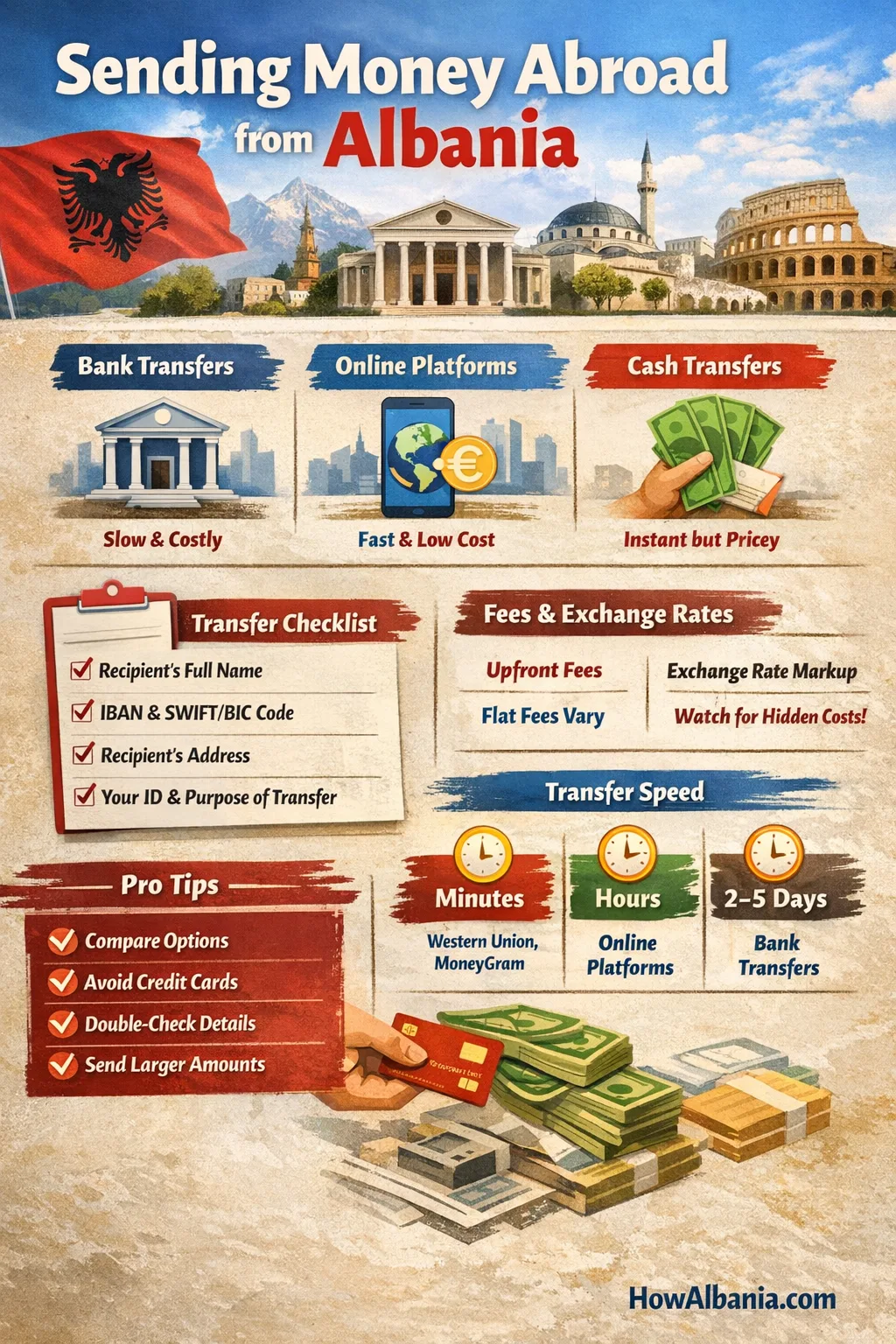
- For Speed: In-person cash transfers via Western Union or MoneyGram are often the fastest, with money arriving in minutes.
- For Low Cost: Online platforms like Wise (formerly TransferWise), Remitly, or WorldRemit almost always offer better exchange rates and lower fees than traditional banks.
- The “Old School” Way: Using your Albanian bank (like BKT, OTP Bank, or Raiffeisen) is reliable and secure, but usually the slowest and most expensive option.
- Be Prepared: For any transfer, you’ll need your recipient’s full name, address, and bank details (especially their IBAN and SWIFT/BIC code). For large amounts (over €10,000), expect to provide extra paperwork.
Your Main Options for Sending Money Abroad
You have three main paths for sending money internationally from Albania. Let’s explore the pros and cons of each.
1. Traditional Bank Transfers (SWIFT)
This is the classic method: walking into your local Albanian bank branch (or using their online banking) to send a SWIFT transfer. All major banks in Albania offer this, including BKT, Intesa Sanpaolo, OTP Bank, and Raiffeisen Bank.
- Pros: Highly secure, reliable, and good for sending very large sums of money directly from your bank account.
- Cons: This is almost always the most expensive option. You’ll face high flat fees (sometimes €25 or more) and a poor exchange rate. It’s also slow, typically taking 2-5 business days for the money to arrive.
- Best for: Large corporate transactions, paying tuition, or when you have no other option and security is your only concern.
2. Online Money Transfer Platforms (The “Fintech” Way)
This is the modern, digital-first approach. Companies like Wise, Remitly, WorldRemit, and Xe have revolutionized the industry. You create an account on their website or app, load money (sometimes via your Albanian debit card or bank account), and send it from there.
- Pros: Significantly cheaper. These services are built to be low-cost. They offer transparent fees and use the “mid-market” exchange rate (the real one you see on Google) or a rate very close to it. They are also fast, with many transfers completing within 24 hours or even instantly.
- Cons: You’ll need to create an account and verify your identity online. Some platforms may have lower sending limits than a bank, at least initially.
- Best for: Almost everyone. This is the recommended method for personal transfers, sending money to family, and paying smaller invoices.
3. In-Person Cash Transfers
This category is dominated by two big names you’ve definitely seen around Albania: Western Union and MoneyGram. You walk into one of their thousands of agent locations (often inside banks, post offices, or shops), pay with cash (Lekë or Euro), and your recipient can pick up cash in their destination country, often just minutes later.
- Pros: Incredibly fast. This is the solution for emergencies. It’s also great if your recipient doesn’t have a bank account, as they can collect physical cash.
- Cons: It can be very expensive, often with high fees and less-than-great exchange rates. It’s also less convenient, as you physically have to go to an agent location.
- Best for: Emergencies, or for sending money to someone who needs physical cash right now and cannot access a bank account.
What You’ll Need: Your Transfer Checklist
Being prepared makes the process 100 times smoother. Before you start your transfer, make sure you have this information from your recipient:
- Their Full Legal Name: Must match their bank account and ID exactly.
- Their Full Address: Including city, postal code, and country.
- Their Bank’s Name & Address: (For bank-to-bank transfers).
- IBAN (International Bank Account Number): This is critical for transfers to Europe, the UK, and many other countries. It’s a long string of numbers and letters.
- SWIFT/BIC Code: An 8 or 11-character code that identifies their specific bank (e.g., CITIUS33). This is essential for all international bank transfers.
- Account Number & Routing Number: For transfers to the USA (instead of an IBAN).
- Purpose of Transfer: You’ll often be asked to state the reason, e.g., “Family Support,” “Invoice Payment,” or “Gift.”
You will also, of course, need your own valid ID (like your Albanian ID card or passport) and the funds for the transfer.
Understanding the True Cost: Fees vs. Exchange Rates
The biggest mistake people make is only looking at the “transfer fee.” The real cost is a combination of two things:
The Upfront Fee
This is the obvious charge. A bank might charge you a €25 flat fee. An online service might charge €1.99 or even zero fees for your first transfer. It’s easy to compare.
The Hidden Cost: The Exchange Rate Markup
This is where they get you! Banks and many transfer services will not give you the real “mid-market” exchange rate.
Example:
- The real rate is: €1 = $1.08 USD
- Your bank’s rate might be: €1 = $1.04 USD
That 4-cent difference is their “markup.” On a €1,000 transfer, that “hidden fee” just cost you $40! Always compare the final amount your recipient will get, not just the initial fee.
How Long Will It Take?
- Near-Instant (Minutes): Western Union, MoneyGram (cash pickup). Some online transfers to mobile wallets.
- Fast (Under 24 Hours): Most transfers via online platforms like Wise or Remitly.
- Slow (2-5 Business Days): Traditional SWIFT bank transfers.
Important Rules and Limits in Albania
Yes, there are rules. The good news is that for most personal transfers, they are very straightforward. Albania’s foreign exchange is regulated by the Bank of Albania.
- No General Controls: For most people, there are no “controls” stopping you from sending money.
- Documentation for Large Amounts: If you plan to send a large sum (think over €10,000 or its equivalent), be prepared. Your bank or transfer service is required by anti-money laundering (AML) laws to ask for more documents. This could include:
- Proof of income (where the money came from).
- The purpose of the transfer (e.g., a signed contract for a house purchase, a university invoice).
- Bank-Specific Limits: Your own bank may have its own *daily* or *monthly* limits for online transfers (e.g., €10,000 per day).
Bottom line: For small, regular transfers, you’ll have no issues. For a big one, call your bank first and ask what paperwork you need to bring.
Pro-Tips for a Smooth and Cheap Transfer
- Always Compare: Never use the same service every time out of habit. Use a comparison site (or just open Wise, Remitly, and your bank’s website) to see who has the best total cost today.
- Avoid Paying with a Credit Card: If possible, fund your transfer with a bank deposit or debit card. Using a credit card can trigger “cash advance” fees from your card issuer, adding another high cost.
- Double-Check Everything: A typo in the IBAN or name is the #1 reason for delays. One wrong number can send your money into limbo for weeks. Double-check. Then triple-check.
- Send Larger, Less Frequent Transfers: If you’re sending support to family, it’s often cheaper to send €300 once a month than €100 three times a month, especially with services that charge flat fees.
Final Verdict: What’s the Best Method for You?
Here’s our simple recommendation:
- For most people, most of the time: Use an online platform like Wise or Remitly. It offers the best balance of low cost, speed, and convenience.
- If you’re in a terrible hurry: Use Western Union for cash pickup, but be prepared to pay a premium for the speed.
- If you’re sending over €20,000: Talk to your traditional bank. Their fees will be high, but they are set up to handle the compliance and paperwork for very large transactions.
Sending money from Albania doesn’t have to be a headache. By skipping the expensive bank counters and embracing modern, transparent services, you can save yourself a significant amount of money and time. Good luck!