Document Attestation and Apostille for Albania — 2026 Complete Guide
If you plan to use an Albanian document abroad or a foreign document inside Albania, this detailed guide explains every step of the apostille, legalization (attestation), and sworn translation process clearly and simply.
What is an Apostille and Attestation?
Apostille is a simplified international certification defined by the Hague Convention of 1961. It allows public documents such as birth certificates, marriage records, criminal background checks, court decisions, and diplomas to be recognized in other member states without additional embassy legalization.
Attestation (Consular Legalization) applies when the destination country is not a member of the Hague Apostille Convention. In that case, the document must go through several levels of authentication — typically by the Ministry of Foreign Affairs and the embassy or consulate of the destination country.
Albania’s Apostille Status (Hague Convention)
Albania is a party to the Hague Convention of 5 October 1961 Abolishing the Requirement of Legalisation for Foreign Public Documents. Therefore, documents issued in Albania are recognized in all Hague member countries once they bear an apostille certificate. Similarly, foreign documents with an apostille are valid in Albania.
Note: Some countries may still require translations or specific formatting. Always confirm the requirements with the destination authority.
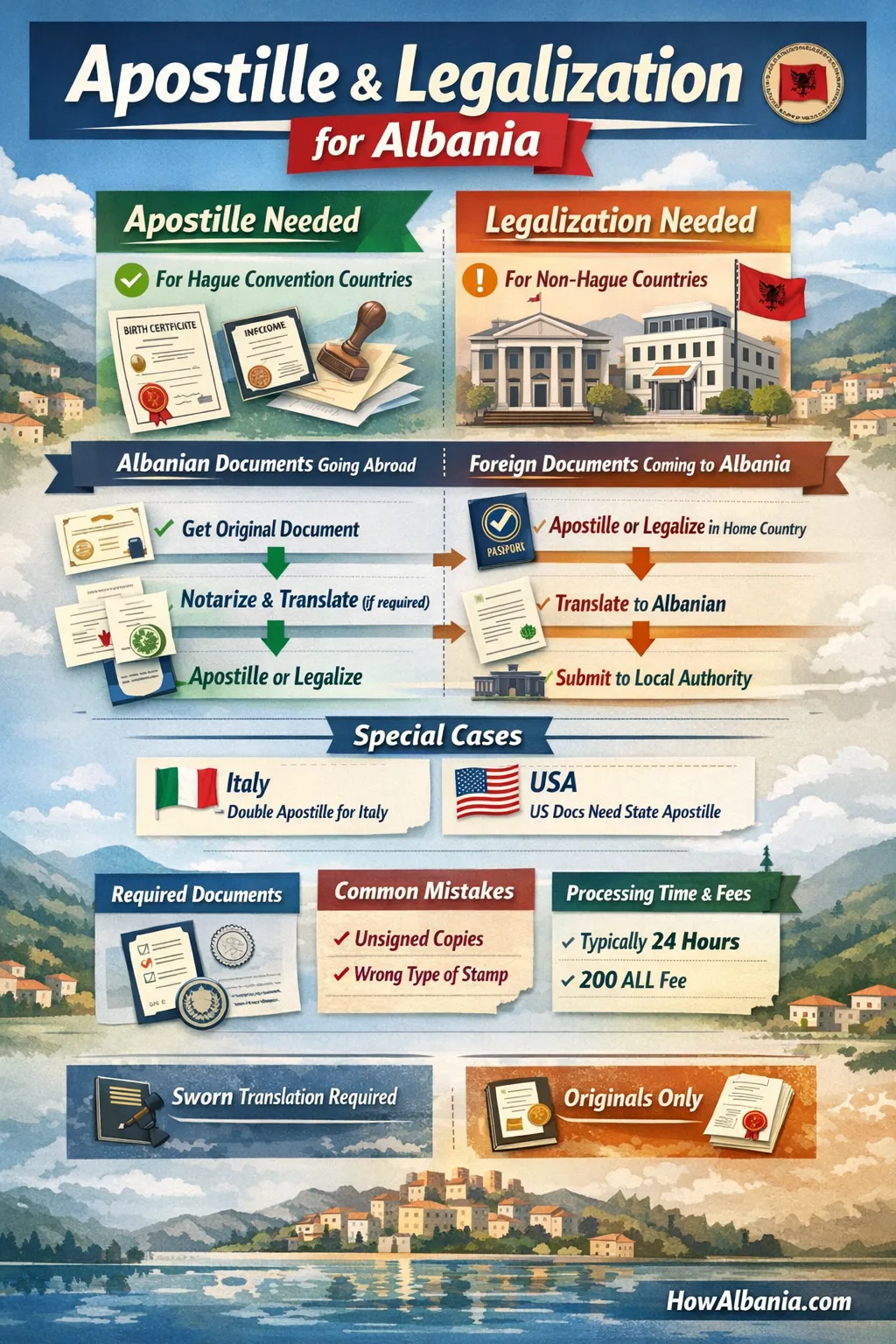
Process Workflows: Two Main Scenarios
Scenario A — Documents issued in Albania to be used abroad
Scenario B — Documents issued abroad to be used in Albania
Common Mistakes:
- Not apostilling the translation — some countries require separate apostilles for both the original and its translation.
- Sending scanned or unsigned copies instead of originals.
- Using only an apostille for countries that aren’t Hague members.
Special Cases & Examples
Italy: “Double Apostille” Practice
For documents from Albania to be used in Italy, both the original document and its Italian sworn translation often require separate apostilles. The process is handled by the MEPJ in Albania, and the translation must be certified locally.
United States
- If an Albanian document is to be used in the U.S.: It needs an apostille from MEPJ. You may use postal services or Albanian diplomatic missions for assistance.
- If a U.S. document is to be used in Albania: It must be apostilled by the Secretary of State in the issuing U.S. state, and then translated into Albanian if required.
Educational Documents (Diploma, Transcript)
Academic documents usually follow this chain: University/Institution validation → Notary (if needed) → Apostille. Some receiving institutions require the document to be in a sealed envelope directly from the issuing university.
Required Documents & Checklist
| Step | What to Prepare | Tip |
|---|---|---|
| Original Document | Signed and sealed official copy | Digital or printed copies without signatures may not be accepted. |
| Notary (if needed) | Certified copy or signature authentication | Check with the destination institution first. |
| Sworn Translation | Certified translation into the destination language | Some countries require the translation itself to be apostilled. |
| Submission | Posta Shqiptare, TNT, AC, AdeX (within Albania) | Keep the tracking number and fill out all forms clearly. |
| Apostille/Legalization | Handled by the MEPJ Legalization Office | If the destination isn’t a Hague member, embassy legalization is also required. |
Fees, Duration & Delivery
- Fees: As of 2025, the MEPJ charges 200 ALL per document for Albanian citizens. Fees for foreigners vary based on reciprocity agreements.
- Average processing time: For domestic postal submissions, apostille/legalization is typically completed within 24 hours (excluding delivery time).
- Delivery: Completed documents are returned by courier. Applicants abroad can collect them through Albanian embassies or consulates.
Does Albania Offer e-Apostille?
According to the Hague Conference on Private International Law (HCCH)’s e-Apostille Program (e-APP), Albania is currently not listed as an active e-Apostille country. Therefore, apostilles in Albania are still issued as paper-based certificates. Always check for updates before applying.
Frequently Asked Questions
1) Which documents can be apostilled?
Public documents such as civil status certificates, marriage/birth certificates, court decisions, criminal records, notarized powers of attorney, and educational diplomas are eligible. Private documents often need notarization first.
2) Does an apostille certify the content of a document?
No. An apostille only verifies the authenticity of the signature and seal on the document — not its content.
3) Does the translation also need an apostille?
Depends on the country. For instance, Italy often requires separate apostilles for both the original document and the translation (“double apostille”).
4) Can I apply from abroad?
Yes. You can apply through the nearest Albanian embassy or consulate, or use Posta Shqiptare from abroad if permitted.
5) What’s the difference between Apostille and Legalization?
Apostille is a single-step certification among Hague member states. Legalization is a multi-step process (Foreign Ministry + Embassy) for non-member countries.
Official Sources (Verification Links)
- MEPJ — Legalization & Apostille Main Page: punetejashtme.gov.al
- MEPJ — Apostille Countries & Postal Info: Shtetet me procedurën e apostillimit
- HCCH — Apostille Overview: hcch.net
- HCCH — Albania Competent Authority: HCCH Authority Listing
- e-APP Implementation Chart: Implementation Chart
- Italian Embassy (Tirana) — Double Apostille Info: ambtirana.esteri.it
- U.S. Embassy (Tirana) — Apostille Guidance: al.usembassy.gov
- MEPJ — Fee Schedule: Tarifa për legalizimin
Disclaimer: Rules and procedures may change. Always check the latest official updates before applying.
This guide is for informational purposes only. Official decisions and procedures belong to the relevant government authorities.